Two-level CO2 Utilization Database
CO2 derived Metal Organic Framework
The reducing of CO2 emission is urgent issue for us. The development of new material that yield high potential on capturing CO2 from atmosphere is urgently needed. One of the most promising solid sorbent is metal organic framework (MOF) family composing of metal node and organic ligands in a certain topology corresponding to the coordination around metal node. In this database, we proposed the concept of two-level CO2 utilization, when the first step is the conversion of CO2 into the ligand for MOFs following by the second step where those MOFs are used as CO2 sorbent. The total CO2 utilization value represents the sum of CO₂ content integrated into the MOF structure plus the CO2 adsorption capacity, maximizing the overall carbon utilization efficiency and contributing to sustainable carbon management strategies.
Level 1: CO₂ is converted into organic ligands through the carbamate formation processes, incorporating directly into the framework's structure. This step demonstrates how CO₂ can be transformed from a waste product into valuable building blocks for advanced materials.
Level 2: The synthesized MOFs, containing CO2-derived ligands, are then utilized as high-performance adsorbents for CO2 capture and storage. This creates a synergistic system where the framework not only contains CO2 structurally but also provides enhanced sites for additional CO2 adsorption.
This innovative approach represents a dual strategy where CO2 serves as a raw material for ligand synthesis and as a target molecule for adsorption. For more details, see the reference.[Ref]: P Mano, S Namuangruk, Chemical Engineering Journal 486, 150248
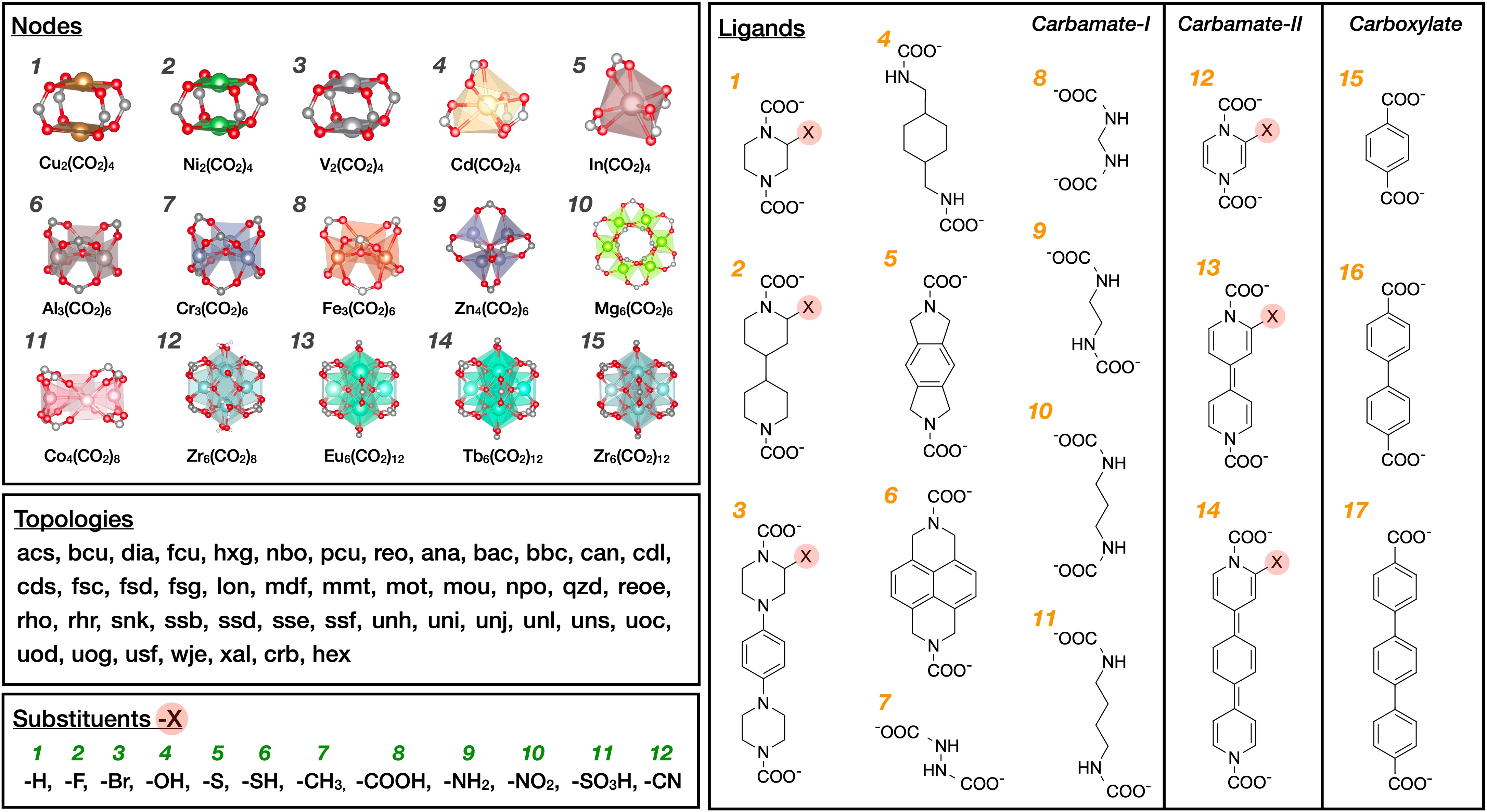
The figure above illustrates the comprehensive mapping of ligands, metal nodes, and substituents to the labelling number for MOFs in our database.